Fast Supply Solutions
We match your technical product needs with the right manufacturers and quickly organize the process for competitive prices and short delivery times.

A boiler chemical programme is designed from feedwater analysis, operating pressure, condensate return, blowdown, metallurgy and manufacturer limits to control scale, corrosion and carryover.
A boiler chemical programme is designed from feedwater analysis, operating pressure, condensate return, blowdown, metallurgy and manufacturer limits to control scale, corrosion and carryover.
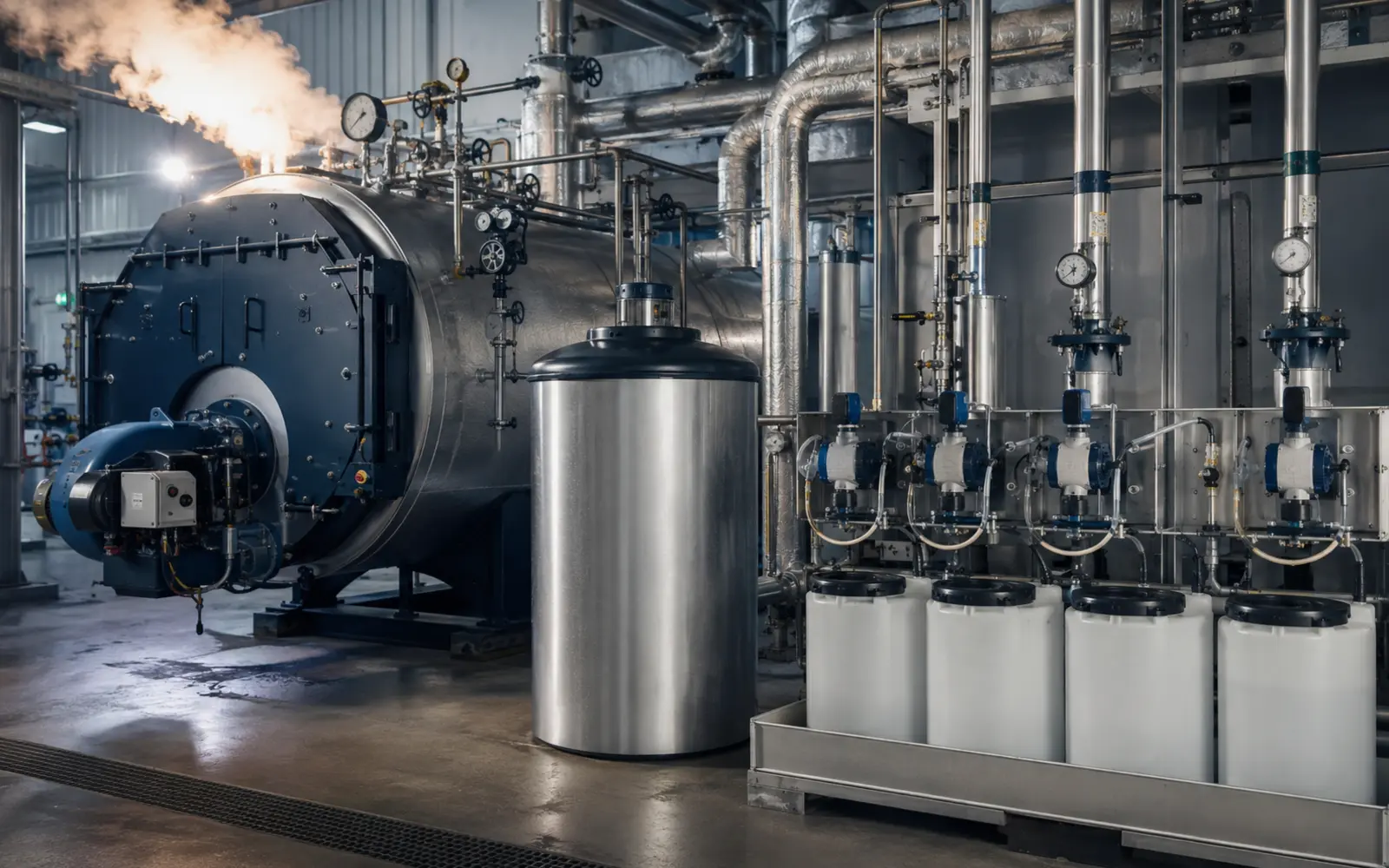
Hardness leakage, silica, iron and suspended solids can deposit on heat-transfer surfaces. Phosphate, polymer and dispersant programmes are selected for boiler pressure and water chemistry.
Residual dissolved oxygen after mechanical deaeration is controlled with an appropriate oxygen scavenger. pH and alkalinity targets reflect feedwater, condensate materials and operating limits.
Conductivity, TDS, pH, alkalinity, programme residual, hardness and iron are monitored. Chemical dose, blowdown and boiler-water concentration are optimized together.
Dose is not one fixed ppm; it is verified from analysis, flow and operating results. Use suitable injection points and separate pumps, and follow SDS storage and incompatibility rules.
| Target | Typical approach | Monitoring |
|---|---|---|
| Scale/deposit | Phosphate, polymer, dispersant | Hardness, phosphate, iron |
| Oxygen corrosion | Deaeration + scavenger | Dissolved O₂ / residual |
| pH/alkalinity | Alkalinity adjustment | pH, alkalinity |
| Concentration | Controlled blowdown | Conductivity, TDS |
No. Dose follows water analysis, feed flow, condensate return and target residuals.
Softening reduces hardness, but oxygen, pH, alkalinity, condensate and hardness leakage still require control.
It controls dissolved and suspended solids concentrated in boiler water.
Full water analysis, boiler pressure/capacity, feed flow, condensate return, blowdown, current programme and problems.