Fast Supply Solutions
We match your technical product needs with the right manufacturers and quickly organize the process for competitive prices and short delivery times.

Panel thickness is determined from the target U-value, core thermal conductivity, indoor-outdoor temperature difference, building use, joint design and local energy requirements. Different cores at the same thickness may not provide the same performance.
Panel thickness is determined from the target U-value, core thermal conductivity, indoor-outdoor temperature difference, building use, joint design and local energy requirements. Different cores at the same thickness may not provide the same performance.
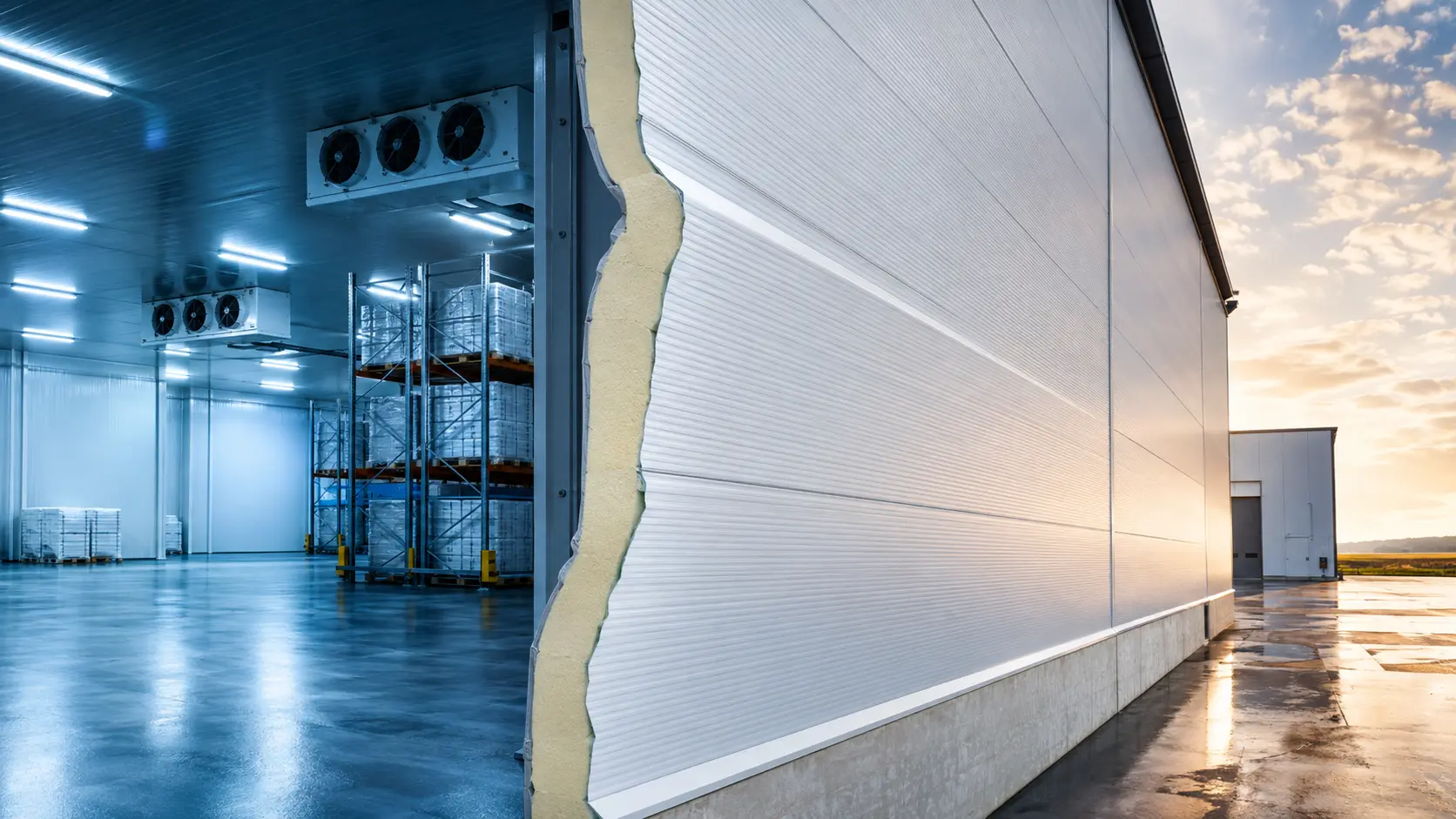
Increasing thickness generally raises thermal resistance and lowers U-value. The actual value must use the declared core conductivity together with facings and joint geometry.
Warehouses, production areas, cold rooms and climate-controlled facilities have different temperature and humidity targets. Cold storage additionally requires condensation, vapour-control and thermal-bridge assessment.
Poor joints, fasteners, purlins and corner details can create thermal bridges and air leakage even when the panel surface performs well. Panel and installation details must be verified as one system.
| Factor | Effect |
|---|---|
| Core λ-value | Material thermal conductivity |
| Panel thickness | Thermal resistance/U-value |
| Temperature difference | Required insulation level |
| Joint design | Thermal bridge/air leakage |
Thermal resistance generally improves, but the optimum thickness balances core, cost, load and project needs.
Generally not; compare declared product values because their conductivities differ.
No. Vapour control, airtightness, joints and condensation risk must also be assessed.
Specify the application, roof or wall type, core material, panel thickness, steel thicknesses, colour, total area, accessories, project location and delivery point. Fire and thermal performance must be confirmed against the project specification before ordering.