Fast Supply Solutions
We match your technical product needs with the right manufacturers and quickly organize the process for competitive prices and short delivery times.

The correct program for boilers, cooling towers, closed loops and reverse-osmosis systems is established by evaluating water analysis, system materials and operating objectives together.
Water-conditioning chemicals control scale, corrosion, dissolved oxygen, biological fouling and membrane fouling. The correct product and dosage must be selected from water analysis and actual system conditions.
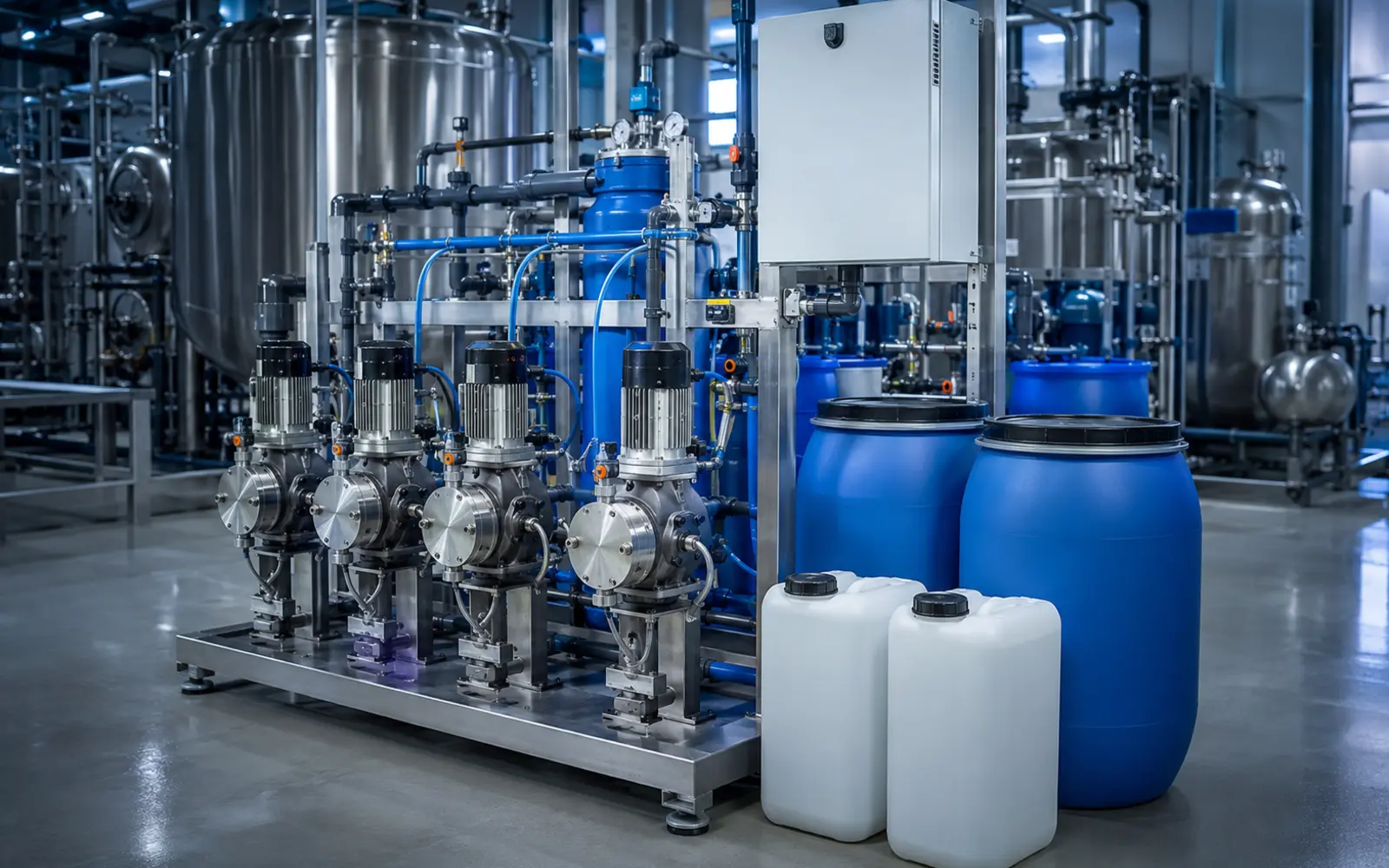
Water treatment separates suspended solids, salts, organic load or microorganisms to achieve a defined water quality. Water conditioning focuses on protecting boilers, heat exchangers, piping, cooling towers and membranes and maintaining stable operation. In most plants the two approaches complement one another.
Boiler programs use scale and corrosion inhibitors, oxygen scavengers and pH adjusters. Cooling-tower programs also use biocides and dispersants. Closed loops depend on maintaining inhibitor reserve. Reverse-osmosis systems use antiscalants, membrane cleaners and preservation products.
Raw and feedwater analysis, flow, temperature, pH, alkalinity, hardness, chloride, silica, dissolved oxygen, organic load and microbiological risk are evaluated. System volume, cycles of concentration, recovery, pressure and metallurgy also affect selection. Dosage must be verified by calculation and field results rather than applied as one fixed value.
Conductivity, pH, hardness, inhibitor reserve, corrosion indicators, microbiological counts and membrane performance are monitored routinely. Dosing equipment is calibrated, chemicals are stored according to safety data sheets and incompatible products are separated. An optimized program can reduce water, energy and chemical consumption.
They control scale, corrosion, dissolved oxygen, biological fouling, deposits and membrane fouling to support equipment efficiency and operating continuity.
Water analysis, flow, system volume, temperature, pressure, materials and operating targets are assessed together; dosage is verified by calculations and field results.
No. Boilers, open cooling systems, closed loops and membrane systems operate under different conditions. Compatibility and dosage must be determined separately.
Provide a current water analysis, system type and volume, flow, temperature and pressure, construction materials, current chemical program and the operating problem.