Fast Supply Solutions
We match your technical product needs with the right manufacturers and quickly organize the process for competitive prices and short delivery times.

Industrial fans are mechanical devices that move air at a defined airflow rate and pressure for ventilation, process extraction, smoke control and pressurisation duties.
An industrial fan moves air at the airflow and pressure required by the project. Correct selection considers system resistance, temperature, air composition, motor, sound and installation conditions as well as fan type.
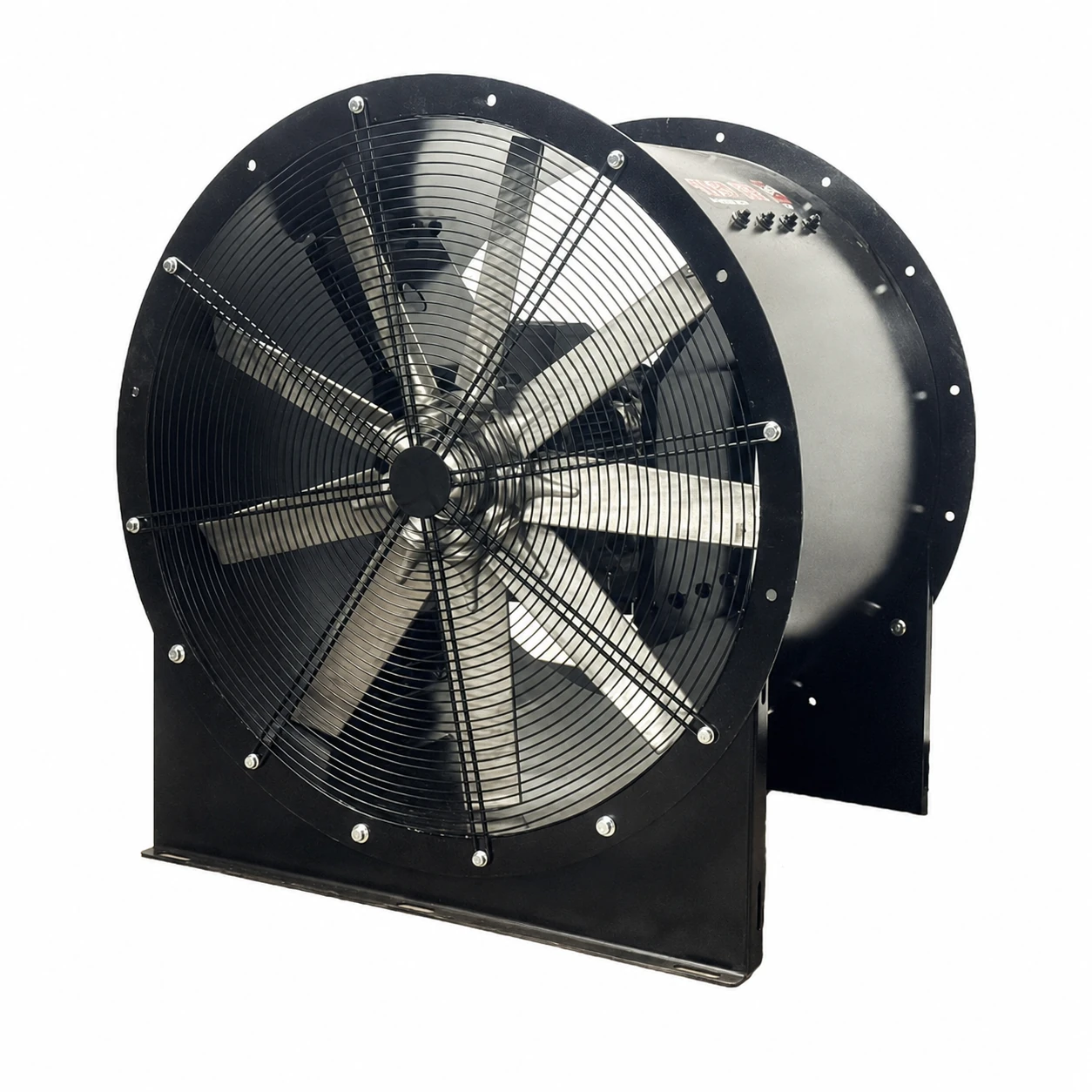
An industrial fan converts motor power into air movement through a rotating impeller. It is used for outdoor-air supply, extraction, cooling or pressurisation in factories, warehouses, car parks, commercial kitchens, plant rooms, production lines and smoke-control systems. Selection must be based on the required airflow and total system resistance, not room size alone.
Axial fans move air parallel to the shaft and are commonly used for high airflow at relatively low pressure. Centrifugal fans draw air into the impeller centre and discharge it radially, making them suitable for systems with greater resistance. Duct fans provide compact in-line installation, roof fans discharge directly at roof level, cabinet fans support acoustic and environmental protection, and jet fans move air in spaces such as car parks. Explosion-proof construction must follow the hazardous-area assessment and project requirements.
Key inputs are duty airflow, static or total pressure, air temperature and density, altitude, contaminants, installation orientation, duct connection, electrical supply, speed control and allowable sound level. Smoke-extract or high-temperature duties also require confirmation of operating duration, temperature rating and the project fire strategy. The duty point should lie in a stable, efficient region of the manufacturer performance curve.
A fan selected only by purchase price may consume excessive energy, generate high noise or operate unstably. Fan and motor efficiency, speed control, duct losses and annual operating hours should be considered together. The design should also provide maintenance access to the motor, belts, bearings, filters and impeller, with suitable vibration isolation and flexible connections.
Provide airflow and pressure, duty description, air temperature and composition, installation location, duct size, electrical supply, motor protection, speed-control requirement, sound limit, quantity and destination. Where calculations are unavailable, the duct route and room use can support a preliminary selection; the final duty must be verified against project calculations and manufacturer curves.
An axial fan moves air parallel to its shaft and is common in high-airflow, lower-pressure duties. A centrifugal fan turns the airflow radially and can overcome greater system resistance.
No. Static or total pressure, temperature, density, sound, installation and electrical conditions must also be defined.
No. The requirement depends on the hazardous-atmosphere risk assessment, area classification and project specification.