Fast Supply Solutions
We match your technical product needs with the right manufacturers and quickly organize the process for competitive prices and short delivery times.

Fan type is not selected from airflow alone. System pressure, duct arrangement, mounting location, conveyed air, temperature, noise, efficiency and maintenance access determine whether an axial, centrifugal, inline or roof fan is suitable.
Fan type is not selected from airflow alone. System pressure, duct arrangement, mounting location, conveyed air, temperature, noise, efficiency and maintenance access determine whether an axial, centrifugal, inline or roof fan is suitable.
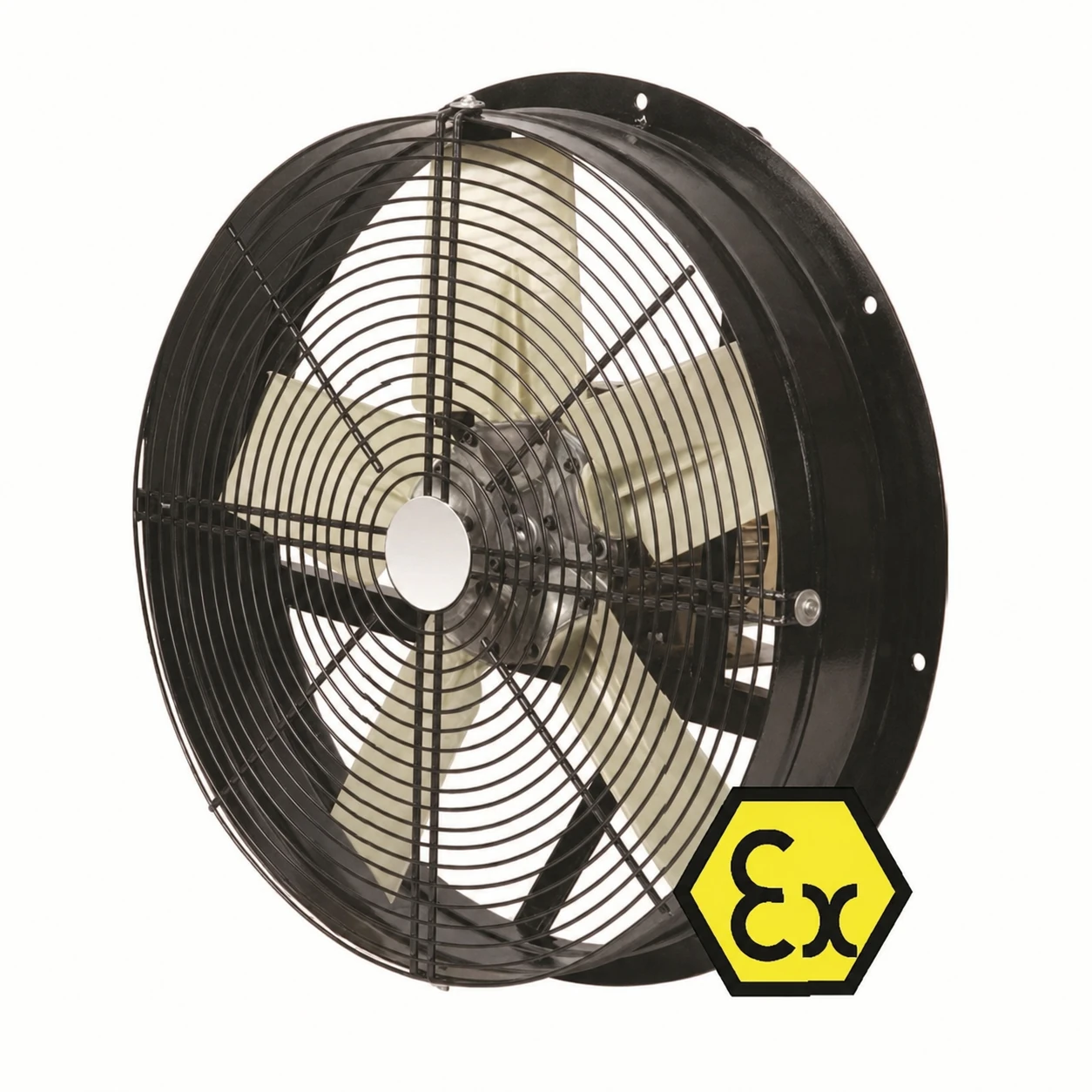
Axial fans move air along the fan axis and are commonly used for high airflow at low-to-medium pressure in short ducts, walls, tunnels, car parks, cooling and process ventilation. Cased, wall, jet and explosion-protected versions suit different duties.
Centrifugal fans draw air into the impeller and discharge it radially, allowing higher system pressures. Impeller geometry and material are important in long ducts, filters, cyclones, process extraction, pneumatic conveying and dusty air.
Compact fans installed directly in circular or rectangular ductwork for general ventilation and local exhaust. Service access, noise, vibration isolation and duct connections must be considered.
Roof fans discharge exhaust air above the building. Weather protection, curb, backdraft damper, wind, access and roof waterproofing must be coordinated.
For every type, design airflow and static/total pressure must meet on the fan curve. Motor power, efficiency, speed, temperature, density, corrosion, particles, ATEX and smoke-extract classification are checked separately.
| Fan type | Strength | Typical application |
|---|---|---|
| Axial | High flow, low-medium pressure | Tunnel, car park, short duct |
| Centrifugal | Medium-high pressure | Long duct, filter, process |
| Inline | Compact in-duct mounting | General supply/extract |
| Roof | Direct roof exhaust | Building and industrial extract |
Only if its curve meets the duct resistance at design airflow.
It often produces higher pressure, but correct selection depends on airflow, efficiency, impeller and system curve.
A suitable curb, waterproofing and service detail are normally required.
Provide airflow, static or total pressure, temperature, air content, duty, electrical supply, mounting, noise and certification requirements.